Stars
The Building Blocks of Galaxies
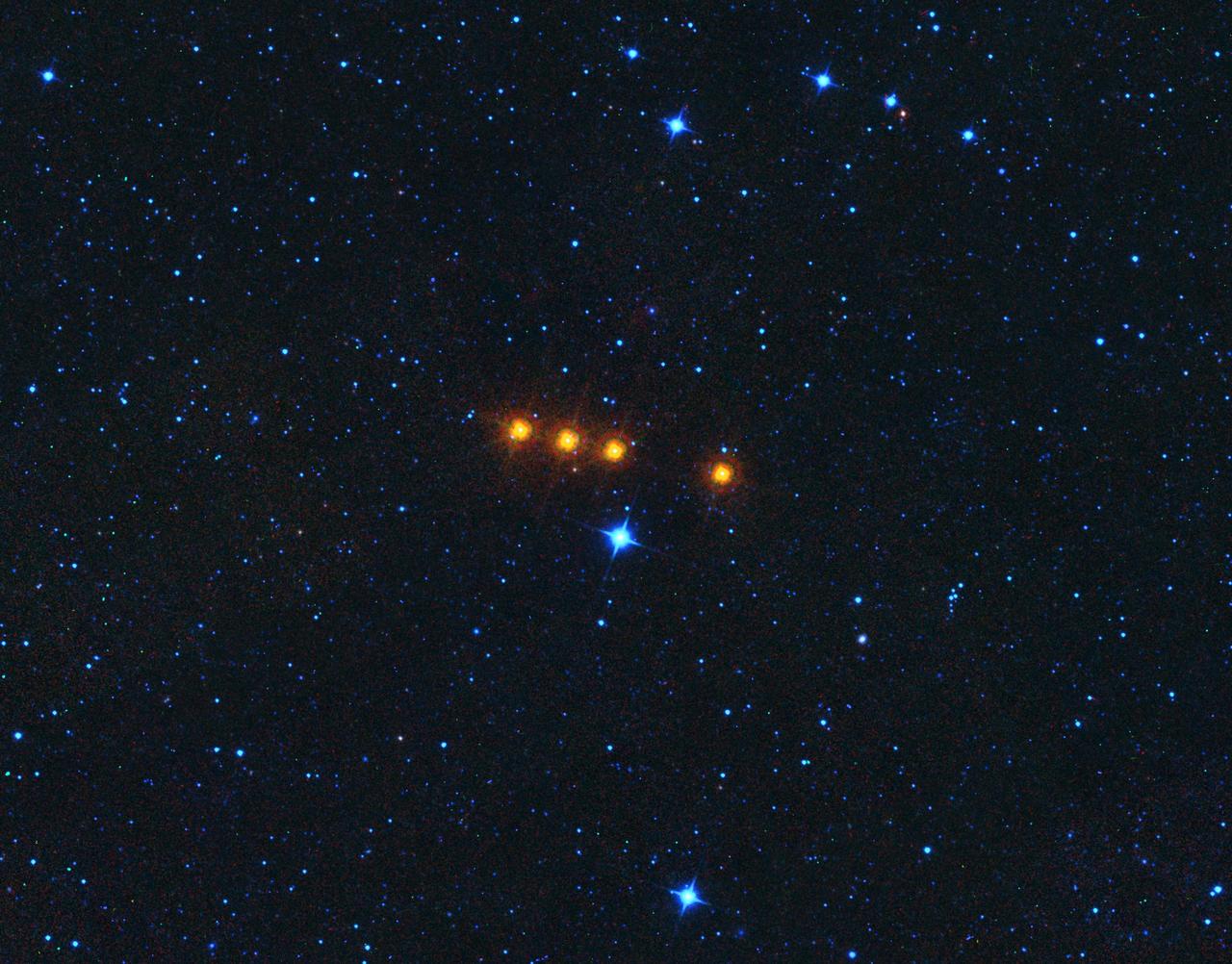
Stars are massive luminous spheres of plasma held together by gravity. They produce light and heat through nuclear fusion, converting hydrogen into helium in their cores. Stars vary enormously in size, temperature, and brightness.
Star Classification
- O-type: Blue, extremely hot (30,000-50,000 K)
- B-type: Blue-white, very hot (10,000-30,000 K)
- A-type: White, hot (7,500-10,000 K)
- F-type: Yellow-white (6,000-7,500 K)
- G-type: Yellow, like our Sun (5,200-6,000 K)
- K-type: Orange, cooler (3,700-5,200 K)
- M-type: Red, coolest (2,400-3,700 K)
Life Cycle of Stars
Stars are born in nebulae, live for millions to billions of years, and die in various ways. Massive stars end their lives in spectacular supernova explosions, while smaller stars shed their outer layers to form planetary nebulae, leaving behind white dwarfs.
Our Sun
Our Sun is a G-type main-sequence star (G2V), about 4.6 billion years old and roughly halfway through its life. It will eventually expand into a red giant, then shed its outer layers, and end as a white dwarf.